
WHS
2016
NUMBER OF ROOMS USED
2
PROJECT DURATION
5 MONTHS
GOALS
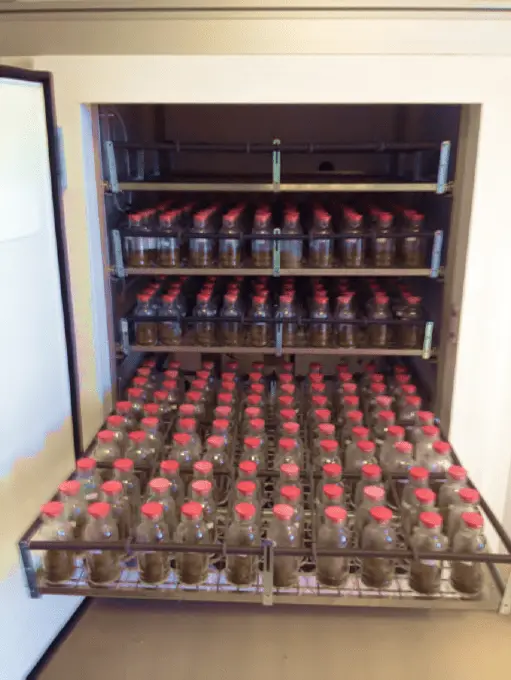
The objective of this project was to assess the resistance and resilience of soil microbial communities to water stress, combined or not with heat stress, in agroforestry systems and in comparison with monoculture systems, under Mediterranean climate conditions.
- Soil samples were taken at various distances from the tree line in the agroforestry system and in the adjacent monoculture system. We maintained soil samples under optimal humidity conditions at 25°C on the one hand, and simulated two cycles of desiccation-rehydration under controlled conditions by applying two distinct treatments on the other: water stress at 25°C and water stress combined with heat stress at 40°C.
- When faced with water stress alone, the resistance and resilience of soil microbial biomass are similar regardless of spatial position in agroforestry systems or in comparison to monoculture systems.
- When faced with combined water and heat stress, microorganisms in the soil between rows or in monoculture systems show higher microbial biomass resistance indices but lower resilience indices than those on and near tree rows.
We have also demonstrated that soil microorganisms can significantly alter their stoichiometry in response to stress. Soil microorganisms show significantly increased MBC:MBN and MBC:MBP ratios during the resistance phase.
After exposure to water stress alone, soil microorganisms show great resilience, quickly recovering stoichiometric ratios similar to those of unstressed microorganisms.
However, when soil microbial communities are exposed to combined water and heat stress, changes in stoichiometry may be irreversible.
Researchers
Esther Guillot ; Isabelle Bertrand ; Philippe Hinsinger
Publications
Guillot, E., Hinsinger, P., … Bertrand, I. (2019). With or without trees: Resistance and resilience of soil microbial communities to drought and heat stress in a Mediterranean agroforestry system. Soil Biology and Biochemistry, 129, 122–135.


