
Facilities
WE ARE CONSTANTLY IMPROVING
EQUIPMENT AVAILABLE FOR
ECOTRON EXPERIENCES

ENVIRONMENTAL SENSORS
Numerous sensors are available to characterize the environmental variables of the experiments:

Climate and weather measurements
Soil parameter measurements
LABORATORY AND PACKAGING AREAS
The Ecotron provides research teams with laboratories equipped to prepare experiments, perform simple analyses, and condition fresh samples. These spaces contain:


PRODUCTION AND DISTRIBUTION OF DECARBONIZED AIR
(CO2 concentration < 1ppm – dew point of -60°C – flow rate of 980m3/h)

The Ecotron is equipped with a production and distribution line for decarbonated air that supplies the Mesocosms and Microcosms trays. This fluid makes it possible to recreate pre-industrial atmospheres (CO2 concentration <200ppm) or, conversely, atmospheres that are very rich in CO2. The isotopic signature of the industrial CO2(13C) injected to obtain the desired concentration level is very different from that of the atmosphere. This process allows for continuous isotopic labeling of experiments.
PRODUCTION ET DISTRIBUTION OF OSMOSIS WATER
The Ecotron is equipped with an osmosis water production system that supplies the three experimental platforms (Macrocosms, Mesocosms, and Microcosms) as well as the laboratories.

The production process consists of three stages
✱ The first step is to remove the calcium from the water in the system (TH> 35°f). This process involves a filtration device and two softeners with their cation exchange resin columns.
✱ The second method involves obtaining water that is virtually free of solutes using the principle of reverse osmosis. The permeate obtained in this way is “pure water” with a conductivity of less than 5µS.
✱ Finally, the third step involves disinfecting and storing the “pure water” produced. In a 3,000-liter stainless steel tank, an ozone layer (30-60 ppb) is maintained, ensuring a contaminant-free atmosphere for the water.
At the start of the distribution network for the experimental cells, a UV lamp (240 nm) destroys the ozone molecules in the water.
For more information about our current projects
MACROCOSMS, MESOCOSMS, MICROCOSMS
OUR OTHERS PLATEFORMES
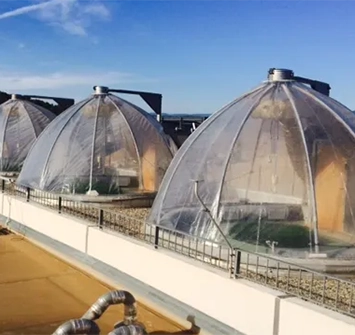
01 MACROCOSMS
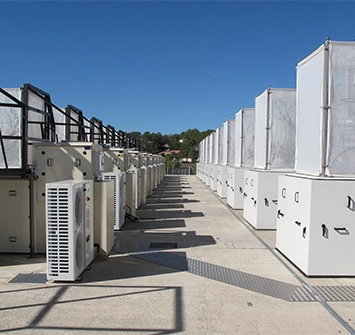
02 MESOCOSMS

03 MICROCOSMS
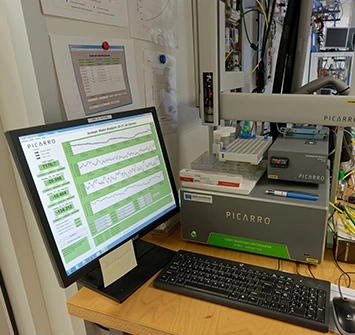
04 ISOFLUX

